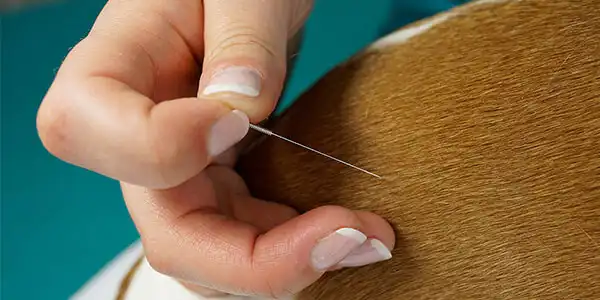
You might associate acupuncture with human wellness, but this ancient healing practice is gaining traction in veterinary medicine too.
Let’s explore how acupuncture works, when it can help, and what to expect if you choose acupuncture for your pet.
What is Acupuncture?
Acupuncture is a branch of Traditional Chinese Medicine in which points along the body are stimulated, often with thin needles, to restore the balance of energy, known as Qi, and promote healing.
Acupuncture releases a variety of substances within the body that relieve pain, including:
- Endorphins1
- Opioids1
- Cannabinoids2
- Serotonin2
Acupuncture also reduces inflammation and improves local circulation.
Acupuncture is most often performed with tiny needles, but there are several other types of acupuncture therapies, including electroacupuncture, laser acupuncture, aquapuncture, moxibustion, and acupressure.
How Is Acupuncture Used for Pets?
The American Animal Hospital Association (AAHA) and American Association of Feline Practitioners (AAFP), now called the Feline Veterinary Medical Association, agree that acupuncture is a safe non-drug therapy for that may provide pain relief in dogs and cats.2
Acupuncture may help manage pain, reduce inflammation, improve circulation, improve mobility, and promote overall wellbeing. Acupuncture is best used as an adjunct or add-on therapy for pain versus a stand-alone treatment. For example, if your pet has arthritis pain and they are not fully responding to an anti-inflammatory pain reliever, then acupuncture may be helpful as an additional treatment.
Most acupuncture sessions require a pet to lie still for 15 to 30 minutes. You can sit with your pet and talk to them or pet areas without needles during the treatment.
In the United States, only licensed veterinarians may become certified to perform animal acupuncture. There are two main organizations that offer certification to veterinarians: The International Veterinary Acupuncture Society and the Chi Institute of Traditional Chinese Veterinary Medicine.
Acupuncture for Cats Versus Dogs
Both cats and dogs may benefit from acupuncture with similar conditions and sessions. An individual dog or cat’s tolerance for the sessions may vary, but often experienced acupuncturists can successfully treat most patients.
Conditions That May Benefit From Veterinary Acupuncture
- Chronic or difficult-to-treat pain including Back and neck pain
- Orthopedic or joint pain, such as pain due to arthritis
- Abdominal disorders, such as pancreatitis
- Post-operative pain: In some cases, cats may require less injectable pain medication after a spay surgery if they receive acupuncture before their procedure.3,4
Acupuncture can also be used for many other disorders in veterinary medicine. Although most of the research is limited and mostly based information in people, not animals. Other potential benefits of acupuncture:
- Newborn resuscitation using Jen Chung acupuncture point stimulation: This may stimulate breathing for puppies and kittens who are not breathing at birth.5
- Cancer support: This can include relief from nausea, pain, neuropathy, lymphedema, and immune support.6
- Skin conditions and non-healing wounds: Acupuncture reduces inflammation and improves immunity to local tissues.7
- Urinary or fecal incontinence: Acupuncture stimulates the nerves controlling urination and defecation to improve their function.6
- Nerve injury (peripheral or spinal cord): acupuncture stimulates the affected nerves to promote healing.6
Where Can Your Pet Get Acupuncture?
Many veterinarians are trained to perform acupuncture. This means you may be able to work with a veterinary acupuncturist in your primary care practice or local area.
Some veterinarians trained in acupuncture have specialty practices where acupuncture can really make an impact, like:
Integrative care. Integrative care varies by practice, but it’s typically a mixture of Western and Asian medicine. It may also include rehabilitation services for pain relief.
Palliative and hospice care. This type of care seeks to relieve pain and provide comfort for pets who have chronic conditions without a cure, such as severe arthritis, spinal pain, or cancer.
Rehabilitation. Veterinary rehabilitation is like physical therapy for people. Since acupuncture reduces pain and inflammation, it’s very helpful to pets in rehabilitation.
Anesthesiology and pain relief. Veterinary anesthesiologists are experts at relieving pain. Many are certified acupuncturists.
Do All Pets Respond to Acupuncture?
Acupuncture has the potential to provide relief with little risk or discomfort for pets with chronic pain or inflammation. When looking for an acupuncturist for your pet, ensure the provider is certified and a veterinarian. Keep a log of your pet’s daily symptoms to see any subtle signs of progress. Acupuncture’s effects are cumulative, meaning the results are better as treatment progresses.
Are There Any Adverse Effects of Acupuncture for Pets?
There are very few adverse effects (side effects) of acupuncture when performed by a trained veterinary professional. The needles are very small and animals typically find the session relaxing. Some pets are tired after their acupuncture session or may drink more water. Muscle twitching or soreness where a needle was inserted is possible but does not last long since the needle size is very small.
Other potential complications include infection or minor bruising or bleeding if the needle is inserted into a vessel.
When Is Acupuncture for Pets Not a Good Idea?
If your pet cannot remain still is highly anxious, aggressive or fearful, acupuncture may not be for them.
Pets with underlying medical issues that cause prolonged bleeding, such as low platelets and coagulation disorders, should not have acupuncture.
If your pet has cancer or an infection, acupuncture may not be the right choice for them. Talk to a certified veterinary acupuncturist for additional guidance.
ZPC-04833

- The Use of Acupuncture for Pain Management. Today’s Veterinary Practice. https://todaysveterinarypractice.com/integrative-alternative-medicine/use-of-acupuncture-for-pain-management/. Accessed March 28, 2024.
- 2022 WSAVA guidelines for the recognition, assessment and treatment of pain. Wiley Online Library Journal of Small Animal Practice. https://onlinelibrary.wiley.com/doi/10.1111/jsap.13566. Accessed March 28, 2024.
- 2015 AAHA/AAFP Pain Management Guidelines for Dogs and Cats. Sage Journals Journal of Feline Medicine and Surgery. https://journals.sagepub.com/doi/10.1177/1098612X15572062?url_ver=Z39.88-2003&rfr_id=ori:rid:crossref.org&rfr_dat=cr_pub%20%200pubmed. Accessed March 28, 2024.
- Analgesic efficacy of laser acupuncture and electroacupuncture in cats undergoing ovariohysterectomy. https://www.ncbi.nlm.nih.gov/pmc/articles/PMC6541842/#:~:text=The%20pain%20scores%20did,24%20hr%20after%20ovariohysterectomy. Accessed March 28, 2024.
- Management of the Neonate in Dogs and Cats. Merch Manual Veterinary Manual. https://www.merckvetmanual.com/management-and-nutrition/management-of-the-neonate/management-of-the-neonate-in-dogs-and-cats. Accessed March 28, 2024.
- Acupuncture in Conventional Cancer Care. Clinician’s Brief. https://www.cliniciansbrief.com/article/acupuncture-conventional-cancer-care. Accessed March 28, 2024.
- Acupuncture in Veterinary Patients. Merck Manual Veterinary Manual. https://www.merckvetmanual.com/management-and-nutrition/integrative-complementary-and-alternative-veterinary-medicine/acupuncture-in-veterinary-patients. Accessed March 28, 2024.