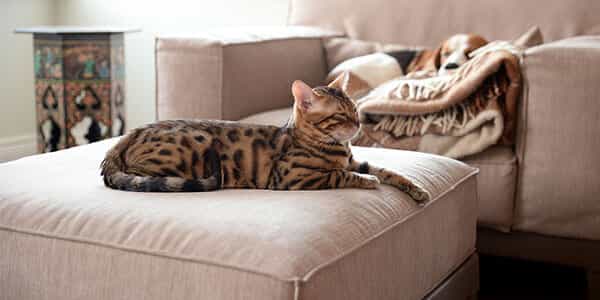
Cats and dogs are crepuscular, which means they’re most active at dawn and dusk. They may take naps during the day, but generally sleep most of the night. They need sleep to maintain their memory and build strength after an active day, just as we do. There are many similarities between your pet’s sleep and yours.
Types of Sleep for Dogs and Cats
There are two main types of sleep for pets and people. Rapid eye movement sleep (REM) is a deep sleep where a human or pet’s eyes may move under their eyelids. You may see your pet twitch, move their lips, or make noises during REM sleep. Non-REM sleep is less deep and occurs throughout most of the sleep cycle.
During REM sleep, new memories become permanent. That makes it incredibly important for people and pets. For example, dogs who do not sleep well may struggle to learn or have behavior issues,1 while those who sleep well are more easily trained.2
How Much Dogs and Cats Sleep?
The amount of sleep that dogs and cats need depends on their age. Each species needs about the same amount, but it does differ a little.
Puppies and Kittens
Newborn puppies and kittens sleep about 22 hours a day, waking only to nurse. As they grow, they gradually become more alert and spend more time awake.
By eight weeks, puppies sleep 18 to 20 hours a day. At four months, puppies sleep about 11 hours a day. One-year-old dogs sleep a smidge less.
Three-month-old kittens sleep about 18 hours a day. By one year, cats sleep about 16 hours a day.
Senior Dogs and Cats
Pets begin to change their sleep patterns as they reach their senior years. Senior dogs sleep longer and may wake up later in the morning.
The older the cat, the more time spent sleeping. While many older pets sleep more, they have less REM sleep and take shorter naps.
Factors that Can Affect Your Pet’s Sleep
Feeding Schedule
The times your pet is fed may influence when they settle down to sleep at night and wake up in the morning.
A study found that dogs who were fed once daily versus twice daily had different sleep patterns. Dogs fed twice daily were more active at night and in the hour before dawn.3
Cats, on the other hand, need to eat many small meals each day, ideally with no more than about eight hours between them. Longer periods without food lead to increased unwanted activity, such as trying to wake you up very early due to hunger.
Daily Activity
The more active your pet is during the day, the more likely they are to become sleepy earlier in the day and spend more time in deeper sleep, or REM sleep.
Stress Levels
Stressed pets may not sleep well enough to have REM sleep and are more likely to have behavior issues and difficulty remembering training. When stress is reduced, REM sleep can return.
Environmental Distractions
Some pets are easily awakened by noises. They may also be roused by the movement of another pet or person nearby.
Sleeping Partners
Depending on their temperament, some pets would prefer to sleep near you or on your bed. If they’re near you, their stress levels will be lower, and they may get into deep sleep and REM sleep more easily. However, less social pets may prefer to sleep on their own.
Signs Your Pet’s Sleep Problem Is a Medical Issue
Changes in your pet’s sleep can be indicators of medical issues, so take note. If any of the following sound familiar, talk with your veterinarian.
Pauses in Snoring or Breathing
Snoring may sound cute, but it’s a sign that your pet’s airflow is partially blocked while they’re sleeping. This is a serious problem for many brachycephalic (short-faced) pets, such as French Bulldogs, English Bulldogs, Pugs, and Persian cats. If your pet has pauses in their breathing or very loud snoring while sleeping, it’s best to see your veterinarian. For some pets, a surgical correction can relieve the airway blockage to help them breathe and sleep more easily.
Restless and Sleeping Less
Pets who are sleeping less or are hyperactive may have an underlying medical issue such as toxin exposure, an overactive thyroid gland (hyperthyroidism), pain, or cognitive dysfunction seen commonly in older pets.
Doesn’t Want to Get Up
A pet who prefers sleep over meals and cuddles with their favorite family members needs a veterinary examination to determine if there is a medical issue.
Waking Up Coughing
If your pet is coughing so much that it consistently wakes you up, they may have a heart or lung issue. Your veterinarian needs to examine them to determine if a medical issue needs to be addressed.
Pain
Pets dealing with pain often don’t sleep as well. Pain comes in many forms, such as osteoarthritis, dental, nerve, urinary, or abdominal pain. Painful pets often can’t get comfortable, so they may get up frequently. Others may stay in the same spot because moving is too painful.
If you notice unusual sleep patterns or breathing problems, it’s important to visit your veterinarian to keep your furry friend healthy and rested.
.jpg)
ZPC-04849

- Sleep Characteristics in Dogs; Effect on Caregiver-Reported Problem Behaviors. PubMed Central. https://www.ncbi.nlm.nih.gov/pmc/articles/PMC9312228/. Accessed April 22, 2024.
- Sleep in the dog: comparative, behavioral and translational relevance. ScienceDirect. https://www.sciencedirect.com/science/article/pii/S2352154619301378. Accessed April 22, 2024.
- Effect of age and feeding schedule on diurnal rest/activity rhythms in dogs. ScienceDirect Journal of Veterinary Medicine. https://www.sciencedirect.com/science/article/abs/pii/S1558787812000068. Accessed April 22, 2024.