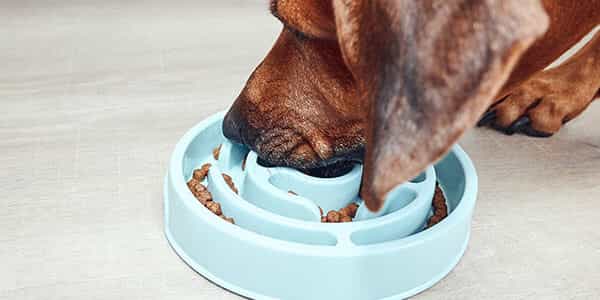
If you’ve ever watched your dog gulp down dinner, guzzle water, and then dash outside for playtime, you’re not alone. Many dogs (especially large/deep chested breeds) seem to live life in fast-forward. But did you know these everyday habits could raise your dog’s risk of a dangerous stomach flip? Stomach flip in dogs (also called GDV) is a life-threatening emergency that every pet parent should know about.
The good news? There are early warning signs and practical, evidence-based preventative measures you can take to help reduce your dog’s risk.
Understanding Stomach Flip (GDV) in Dogs
The medical terms for this condition are gastric dilatation and volvulus (GDV) or gastric torsion. It includes two elements:
- Gastric dilatation (bloat). With gastric dilatation, a dog’s stomach bloats because it fills with gas, fluid, or food. While this isn’t dangerous on its own, it can be very uncomfortable and lead to something much more serious.
- Volvulus (stomach flip). A volvulus occurs when the bloating continues to a dangerous degree. The enlarged stomach twists, blocking the entrance from the esophagus and exit to the intestines. This traps the contents inside the stomach, causing increased stretching and pain, and ultimately cutting off the stomach’s blood supply and damaging tissue. This is a serious medical emergency
- As the flipped stomach continues to expand, it compresses the large vessels that return blood to the heart, causing circulatory shock and multi-organ dysfunction. It also pushes against the diaphragm, making breathing more difficult and reducing the amount of oxygen reaching the organs and tissues.
This cascade of events is fatal if not treated immediately. Dogs can die within a couple of hours once volvulus signs start.
Breeds Predisposed to GDV or Bloat 1-3
Dogs of any age, size, and breed can get GDV, but it’s more common in large and giant deep-chested breeds, such as:
- Akita
- Basset Hound
- Bloodhound
- Boxer
- Doberman Pinscher
- German Shepherd
- Golden Retriever
- Gordon Setter
- Great Dane
- Irish Setter
- Irish Wolfhound
- Newfoundland
- Old English Sheepdog
- Saint Bernard
- Standard Poodle
- Weimaraner
Risk Factors and Early Signs of GDV
While the exact cause of GDV is unknown, there are certain risk factors and behaviors that can play a role. The key to improving your dog’s chance of surviving GDV is to minimize risk factors and catch the signs of bloat and stomach flip early.
Risk Factors
- Age. GDV is more common in older dogs. Risk increases by 20% each year after 9.4
- Size. Deep-chested, large, male dogs are at greater risk.2 Their physical structure allows more room for the stomach to bloat and twist. Dogs over 100 pounds have about a 20% risk of bloat.2
- Genetics. First-degree relatives of a dog with a history of GDV are more likely to have this condition.
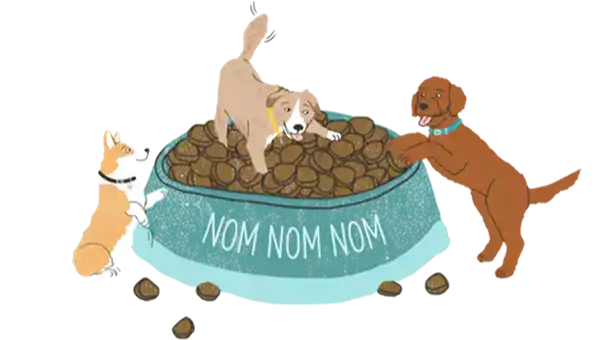
- Eating speed and amount. Eating large meals and fast eating can increase air in the stomach.
- Eating position. Feeding from a raised bowl can increase the risk of GDV by 20% to 52% due to increased ingestion of air.5
- Water intake. Consuming large amounts of water can also increase ingestion of air.
- Activity after eating. Vigorous exercise after eating a large meal can be a trigger.
- Diet high in oil and fat. Food that lists oil among the top four ingredients is shown to increase risk.1 High fat is also a potential trigger.
- Nervous temperament. Nervous dogs may eat fast, and stress can cause the stomach to empty more slowly.
- Body condition. While it’s vital to make sure your dog is not overweight, lean dogs may be at higher risk for GDV because the lack of fat in the abdomen allows more room for the stomach to twist.
Early Signs
Early signs of GDV include:
- Distressed or restless behavior
- Bloated belly, most obvious on the left side
- Excessive drooling
- Pale gums
- Panting or difficulty breathing
- Painful belly
- Vomiting or gagging without producing food or liquid
- Weakness or collapse
GDV and Bloat Prevention in Dogs
There’s no single trigger for GDV, but there are many prevention tactics you can employ to limit your dog’s risk.
Feeding and Meal Management Strategies
- Feed multiple small meals daily instead of one or two large meals.
- Measure or weigh your dog’s food to avoid overfeeding.
- Try food with larger pieces, ideally more than 30mm.6
- Mix wet food into dry kibble to increase particle size and slow eating.
- Feed a diet with rendered meat and bone meal (MBM) in the ingredient list, to decrease the risk of GDV by as much as 53%.7
- Avoid adding water to dry food with citric acid in the ingredient list because it will expand and produce gas, leading to a 320% increase in bloating risk.7
- Use slow-feeder bowls or puzzle feeders.
- Avoid feeding from elevated bowls.
- Provide constant access to water.
- Ask your veterinarian how to avoid diets high in fat and oil.
- Avoid adding water to dry food with citric acid in the ingredient list because it will expand and produce gas, leading to a 320% increase in bloating risk.7
- Use slow-feeder bowls or puzzle feeders.
- Avoid feeding from elevated bowls.
- Provide constant access to water.
Exercise, Stress, and Lifestyle Modifications
- Maintain an ideal weight.
- Avoid heavy exercise or long walks 60 to 90 minutes before and after a meal.
- Avoid car travel one hour before and after a meal.
- Keep your dog’s routine and feeding schedule consistent.
- Be sure your dog is calm before feeding and feed in a quiet, low-stress environment.
- In multi-dog households, feed dogs in separate rooms to lessen stress.
- Use calming aids, such as treats and pheromone diffusers, to ease anxiety.
- Consult with your veterinarian or a certified canine behavior consultant on ways to manage your dog’s stress, if needed.
Surgical Options for GDV
While basic bloat can be treated without surgery, gastropexy is one of the most effective surgical options for preventing stomach flip. It’s also part of the primary treatment after a dog’s stomach flips. Gastropexy for dogs involves surgically attaching a portion of your dog’s stomach to the abdominal wall to prevent twisting.
Preventative Gastropexy
This procedure can be done at the time your dog is spayed or neutered and may be recommended by your veterinarian if your dog has risk factors. It’s often safer, less expensive, and has less anesthetic and surgical risk when done preventatively, vs. waiting for GDV to develop.
Some pet insurance plans even cover preventative gastropexy.
Recovery is likely to be easier with the preventative procedure and may include exercise restriction for 14 days or more and monitoring the incision site.
Emergency Treatment
If your dog’s stomach does flip, surgery will be required to return the stomach to its proper orientation, and a gastropexy will be done to prevent the stomach from flipping again. The gastropexy decreases the risk of recurrence to 3% to 5%.1
These emergency procedures are more costly, with greater anesthetic and surgical risks since your dog is already in critical condition due to the GDV.
Recovery can be more complicated depending on your dog’s condition before surgery, the level of supportive care they need, and the impact of other medical conditions.
GDV is a medical emergency. While any dog can experience bloat and stomach flip, large and giant breeds have as much as a 36% chance of developing these conditions in their lifetime.8 That’s significant.
Take charge of your dog’s health by reviewing these GDV prevention strategies with your veterinarian and help spread awareness in your community. Your proactive steps could save your dog’s life.
ZPC-05255
- Gastric Dilatation Volvulus (GDV) or “Bloat.” Cornell College of Veterinary Medicine. https://www.vet.cornell.edu/departments-centers-and-institutes/riney-canine-health-center/canine-health-topics/gastric-dilatation-volvulus-gdv-or-bloat. Accessed February 25, 2026.
- Bloat: Gastric Dilatation and Volvulus in Dogs. VCA Animal Hospitals. https://vcahospitals.com/know-your-pet/bloat-gastric-dilatation-and-volvulus-in-dogs. Accessed February 25, 2026.
- Risk Factors for Canine Bloat. Tufts University School of Veterinary Medicine. https://www.vin.com/apputil/content/defaultadv1.aspx?pId=11165&id=3848657. Accessed February 25, 2026.
- Gastric Dilatation and Volvulus (GDV) and Bloat in Dogs. Washington State University College of Veterinary Medicine. https://hospital.vetmed.wsu.edu/2025/12/17/gastric-dilation-and-volvulus-gdv-and-bloat-in-dogs/. Accessed February 25, 2026.
- Glickman LT, Glickman NW, Schellenberg DB, Raghavan M, Lee T. Non-dietary risk factors for gastric dilatation-volvulus in large and giant breed dogs. Journal of the American Veterinary Medical Association. 2000 Nov 15;217(10):1492-9. https://pubmed.ncbi.nlm.nih.gov/11128539/. Accessed February 25, 2026.
- Bloat: Is Kibble Really the Problem? Nutrition RVN. https://nutritionrvn.com/2021/03/05/bloat-is-kibble-really-the-problem/. Accessed February 25, 2026.
- Jerold S. Bell, DVM. Risk Factors for Canine Bloat. Tufts University School of Veterinary Medicine. https://www.vin.com/apputil/content/defaultadv1.aspx?pId=11165&id=3848657. Accessed February 25, 2026.
- Piras IS, Perdigones N, Zismann V, Briones N, Facista S, Rivera JL, Rozanski E, London CA, Hendricks WPD. Identification of Genetic Susceptibility Factors Associated with Canine Gastric Dilatation-Volvulus. Genes (Basel). 2020 Nov 5;11(11):1313. https://pmc.ncbi.nlm.nih.gov/articles/PMC7694454/. Accessed February 25, 2026.