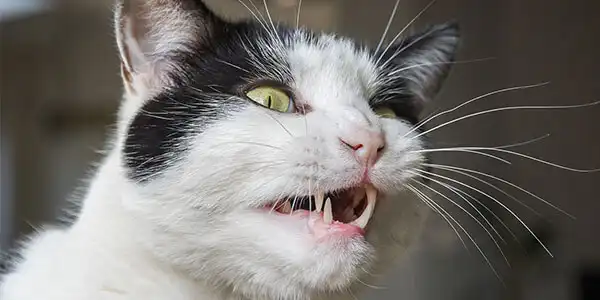
You probably already know that cats and dogs have a much better sense of smell than people do. It’s not just a helpful tool; it’s essential for their survival. So essential, in fact, that they have a specialized smelling behavior called the flehmen response. Dogs and cats don’t have this response to a scent all the time, and cats are more likely to show a flehmen response — you’ll recognize it as a funny face and even teeth chattering.
Let’s discover what your pet’s fascinating flehmen response really means.
What Is the Flehmen Response?
The flehmen response is a special way dogs and cats smell and analyze certain scents or chemical messengers called pheromones.
Sometimes these chemical messengers are a direct form of communication — one animal telling another animal something important. At other times, our pets are simply gathering information and investigating by taking in scents or pheromones through their nose using the flehmen response.
Identifying the Flehmen Response
When your pet exhibits the flehmen response, you’ll see their upper lip curl back, revealing their front teeth and gums, and causing wrinkles near the nostrils. They’ll hold their mouth slightly open and may extend their neck and elevate their head. You may notice your pet chatter their teeth, or “smack their lips” as part of their flehmen response. A cat may lick their nose.
It may look like your pet is being aggressive or even laughing. In fact, “flehmen” is a German word that means “to bare the upper teeth.” It comes from “flemmen”, an Upper Saxon German word meaning “to look spiteful.”1
Why Are Pheromones So Important?
To understand the importance of the flehmen response, it’s helpful to know a bit about pheromones.
Pheromones are chemicals that dogs and cats (and other animals) release into the environment. These chemical signals can impact their behavior.
Pheromones play a vital role in cat and dog life. They mark the boundaries of established territory, help puppies and kittens find their mother’s milk, help identify friend from foe, reproductive status, stress levels, and so much more. That’s why it’s so important for cats and dogs to be able to receive and analyze pheromone signals accurately. The flehmen response is one part of that process.
The next time your cat or dog makes that funny face, like curling their lip, showing or chattering their teeth, they’re not just being silly. They’ve detected an interesting smell or pheromone and are carefully analyzing it to understand their environment better. This behavior is a glimpse into how your pet’s amazing sense of smell helps them communicate and stay safe.
ZPC-04845

Flehmen Response. Wikipedia. https://en.wikipedia.org/wiki/Flehmen_response. Accessed June 24, 2025.