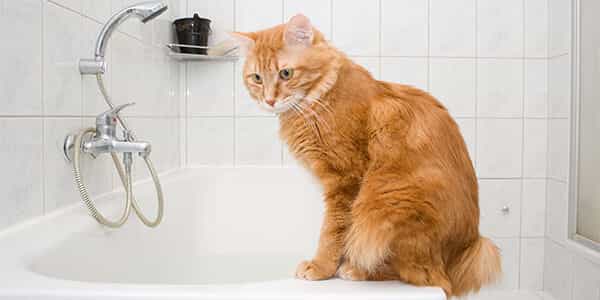
Do cats like water? While a few cats might enjoy the occasional splash or bath, most would rather steer clear of getting wet. Though we can’t ask them directly why they dislike water, we can make some educated guesses by looking at their evolution, natural behaviors, and physical traits. From a cat’s point of view, avoiding water actually makes a lot of sense.
Let’s explore some of the key reasons why cats and water often don’t mix.
Water Is Uncomfortable to Cats
When a cat’s coat is wet, it’s much heavier than normal. This is uncomfortable and potentially risky. Cats are agile and quick for two important reasons — hunting and avoiding being caught by predators. If they’re suddenly weighed down by a wet coat, they will be less agile, slower and, by extension, less safe.
Cats aren’t great swimmers and wet areas, like bathtubs or creek beds, tend to be slippery. Both mean it’s harder to make a hasty exit. As a prey animal, that’s unsafe, so they want to avoid it.
Cats Evolved Without Water
Our modern-day housecats are descendants of desert-dwelling cats. Their ancestors weren’t exposed to much water in the form of rain showers or standing water. Most cats never adapted to swimming, nor did their coats evolve to protect them when wet. Since today’s cats haven’t changed much from their ancient ancestors, they have maintained an aversion to being wet. Getting wet wasn’t a part of their daily life, and they weren’t programmed to deal with it.
Water Makes Cats Cold
Cats prefer warmth and a wet coat makes them cold. In fact, the most comfortable external temperature, also called the thermoneutral zone, is approximately 86 to 101 degrees Fahrenheit. This is much higher than a human’s thermoneutral zone which is 64-77 degrees Fahrenheit.1 A wet coat is likely to cool cats to an uncomfortable temperature.
Water Makes Cats Feel Unclean
Cats are very particular about having anything on their coat. Since it’s not typical for cats to get wet, their instinct is to remove water from their coat. It’s like they’re covered in a foreign substance and need to lick it off as quickly as possible.
Water Can Eliminate a Cat’s Natural Scent
A cat’s scent is extremely important. In fact, a stressed or fearful cat will often surround themselves with their own scent to self-soothe. They do this in many ways, including rubbing on things, scratching surfaces to deposit scent from their paws, and even spraying.
When a cat is soaked with water, it can wash away some of their natural scent, as well as the group scent they may have created by licking and rubbing on their bonded cat friends. This can be stressful for them. It can also cause issues with other cats in the home. They use scent as a primary way to identify “safe” cats from stranger cats. When a cat smells different, they don’t recognize them, leading to stress and possibly aggression. This is why cats often show signs of fear and aggression when one cat comes home from the veterinarian. The change in that cat’s scent triggers a stress response from the cat who stayed home.
It’s also important to remember that chemicals and other things in water have a scent and cats are very sensitive to this. We’ve all grabbed a glass of water from the tap at some point and noticed an odd smell. That same smell causes cats to avoid water.
Cats Have Negative Experiences with Water
Cats generally dislike water, so their first experience getting wet is often negative. Maybe they fell into a bathtub, curiously hopped into a running shower, or were bathed after getting dirty. Such experiences can create negative associations with water. To help cats overcome this, gradual, positive desensitization is needed to help them get more comfortable around water.
Cats Who Like Water
Some cats enjoy water for reasons that are not fully understood. Water-loving breeds like the Maine Coon, Norwegian Forest Cat, and Japanese Bobtail, have coats designed to repel water
Bengal and Savannah cats are hybrid breeds arising from crossbreeding the wild Asian Leopard Cat and domestic cat, or the Serval and domestic cat. These breeds often live near water.
For others, the reasons are less clear. For example, you may find Turkish Vans, American Bobtails, Turkish Angoras, Abyssinians, and Manx enjoying water, and the occasional mixed-breed domestic cat, too. Learn more about these water-loving cat breeds with the Breed Explorer.
Regardless of breed, all cats are unique creatures with their own likes and dislikes including their preferences around water. That’s what makes them special.
ZPC-04702

- The heat is on: the feline TNZ. Veterinary Ireland Journal. https://www.veterinaryirelandjournal.com/small-animal/333-the-heat-is-on-the-feline-tnz. Accessed March 19, 2024.