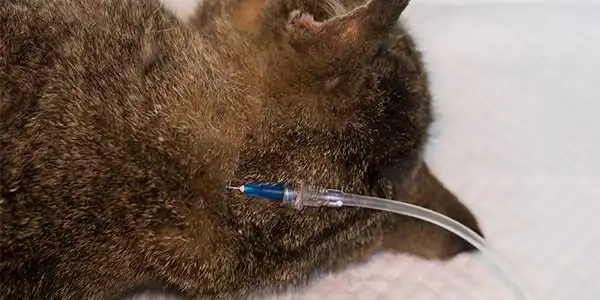
At some point in your cat’s life, your veterinarian may recommend that you give them subcutaneous fluids at home. While this may sound scary, the process is simple and offers important health benefits especially for dehydration or chronic illness.
What Are Subcutaneous Fluids?
Subcutaneous fluids, often called “Sub-Q fluids,” means giving a balanced electrolyte solution under the skin. Vitamins and medications can be added to the fluids by your vet depending on your cat’s needs. Sub-Q fluid administration corrects dehydration more quickly and efficiently than drinking water.
The fluids are injected under the skin using a large-gauge needle through one of two methods: from a fluid bag, just like an IV bag in a hospital, or using a syringe to inject the fluid under the skin. Your cat’s body will absorb the fluids quickly.
Where You’ll Give Subcutaneous Fluids to Your Cat
Sub-Q fluids for cats are given in areas with loose skin. Most commonly fluids are administered between the shoulder blades on the back. Your veterinarian will advise the best location for your cat.
Health Conditions That May Require Subcutaneous Fluids
Essentially, any condition that causes increased water loss or dehydration can benefit from subcutaneous fluid administration, such as:
- Gastrointestinal issues that cause vomiting and diarrhea
- Hyperthyroidism1
- Cancer2
- Constipation
Frequency and How Much Subcutaneous Fluids to Give Your Cat
Subcutaneous fluid administration should always be done under the guidance of your veterinarian. Your veterinarian will tell you exactly how much and how often to give subcutaneous fluids to your cat. Two to three times a week is common, but this varies depending on the cat’s needs.
Preparing for Your Cat’s Subcutaneous Fluid Session
Setting up a calm, cat-friendly environment can make the process smoother. Helpful tools and prep tips include:
Comfort Tools
- Pheromone diffuser or sprays in the area about 30 minutes before you start.
- Calming treats.
- A cozy towel, blanket, or your cat’s favorite bed.
- A helper or secure carrier to reduce movement
Supplies Needed:
- Sterile fluid bag (from your vet)
- Tubing set (if using a bag)
- Sterile 18-20 gauge needles (1 per session)
- A hook or hanger to suspend the fluid bag (~3 ft above your cat)
- A marker to track fluid levels
- High-value treats or wet food
- A clean work surface
- Sharps container for needle disposal
Setting Up the Equipment
- Wash your hands and sanitize your work surface.
- Attach the drip set to the fluid bag by inserting the sterile pointed end into the bag’s port.
- Hang the fluid bag above your cat’s resting area.
- Fill the bulb chamber by squeezing it until halfway full.
- Prime the line and remove air bubbles: open the line lock and let fluid run through until air is cleared, then close the lock.
- Attach the sterile needle, leaving its protective cap on.
- Warm the fluid bag in warm water for 10–15 minutes. Test fluid temperature—it should feel neutral on your wrist.
- Mark the fluid bag with start and finish lines (e.g., Start: 900ml, Finish: 800ml for 100ml dose).
- Set up your cat’s area, ensuring the fluid line reaches comfortably.
How To Give Subcutaneous Fluids to a Cat
The whole process will take 5 to 10 minutes.
- Get your cat settled in their preferred spot (blanket wrap or carrier if needed).
- Remove the needle cap and hold the needle.
- Lift the skin to form a “tent” and insert the needle horizontally into the base of the tent—avoid pointing downward.
- Release the skin and open the line lock to begin fluid flow.
- A soft bubble will form under the skin as fluids are administered—this is normal.
- Keep your cat calm using gentle petting or treats.
- If flow stops, gently adjust the needle angle without removing it.
- Monitor fluid level until it reaches your marked “finish” line.
- Close the line lock and remove the needle.
- Apply pressure to the needle site to minimize fluid leakage.
- Cap the used needle carefully, remove the used needle and place it in the Sharps container.
- Replace the needle on the line with a new, capped sterile needle for next time.
- Store the equipment in a clean, dry place out of direct sunlight.
Be sure that the bag of fluids is not cloudy or discolored before each use. If you notice this, the fluids are contaminated and should not be used. Never give more than the prescribed amount of fluids. If this happens, seek veterinary guidance immediately.
How Long Can a Cat Receive Subcutaneous Fluids?
Your veterinarian will determine the frequency and duration of subcutaneous fluid administration for your cat. Some cats may need ongoing, lifelong fluid therapy, while others may only need a few sessions. Most cats tolerate subcutaneous fluids well when done as directed. Your vet will guide you on how long to continue fluids and will monitor your cat’s progress.
ZPC-04819

- Hydration. Cornell University College of Veterinary Medicine. https://www.vet.cornell.edu/departments-centers-and-institutes/cornell-feline-health-center/health-information/feline-health-topics/hydration. Accessed July 7, 2025.
- Concerned About Your Cat’s Health? Recognizing Lymphoma Symptoms. Impri Medicine. https://www.imprimedicine.com/blog/cat-symptoms-of-lymphoma. Accessed July 7, 2025.