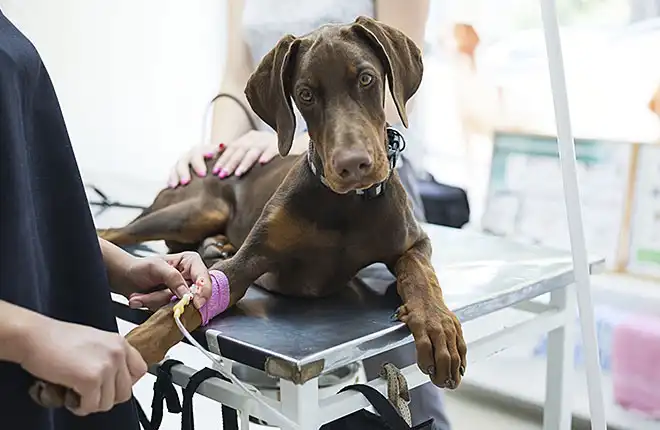
Liver disease in dogs can be a serious and sometimes silent threat to your pet’s health. The liver does many important jobs, like filtering toxins, helping with digestion, and storing energy. When it isn’t working right, your dog’s whole body can be affected. Knowing what to watch for and how to respond can help you take the best care of your best friend.
What is Liver Disease in Dogs?
Some liver diseases are hereditary or congenital and could occur at a young age, while others are more likely to occur later in life. Liver damage can be classified based on the disease process. The liver can be impacted by a systemic disease involving another organ. Sometimes, the liver is impacted by a primary liver disease, such as:
- Hepatitis (liver inflammation)
- Cirrhosis/fibrosis (when healthy liver tissue is replaced with scar tissue)
- Bile duct obstructions (blockage)
- Gall bladder inflammation
- Circulatory or blood vessel abnormalities
- Cancer
- Toxin
Signs of Liver Disease in Dogs1,2
It can be easy to miss some of the clinical signs of liver disease in dogs, since they can be similar to other problems your dog could have. Common signs of liver disease include:
- Vomiting, diarrhea, or evidence of blood in the stool
- Change in appetite
- Change in behavior (aggression, depression, reduced activity, or incoordination)
- Lethargy
- Increased or decreased drinking or urination
- Jaundice (yellowing of the gums, eyes, and ears)
Breeds at Risk for Liver Diseases
| Breed | Disease | Predisposition |
|---|---|---|
| Doberman Pinscher | Chronic | Hepatitis |
| Labrador Retriever | Chronic | Hepatitis |
| West Highland White Terrier | Copper | Hepatopathy |
| Cocker Spaniel | Chronic | Hepatitis |
| Cairn Terrier | Chronic | Hepatitis |
| Dalmatian | Copper | Hepatopathy |
Diagnosing Liver Disease in Dogs
Diagnosing liver disease in dogs usually starts with a visit to your veterinarian. They’ll ask about your dog’s signs and do a physical exam. To get a clear answer, they may recommend:
- Complete blood count (CBC) - Evaluates white and red blood cell counts for anemia (low red blood cells), inflammation, infection, and platelet counts.
- Chemistry and electrolyte panel - Tests specific to the liver can be evaluated as well as liver products, proteins, kidney values, and electrolytes.
- Bile acids study - Elevated bile acid levels confirm the presence of liver disease and may help determine the cause. They also evaluate liver function.
- Blood coagulation tests - Evaluate the ability of the blood to clot in case there is decreased liver function. The liver makes many of the clotting factors.
- Abdominal radiographs (x-rays) - Determine the size, shape, and location of the liver to assist with diagnosis.
- Abdominal ultrasound - A real-time sonogram provides detailed images of the liver and other abdominal organs to evaluate liver texture, circulation, and the other abdominal organs to assist with diagnosis.
- Liver biopsy - A piece of liver tissue is obtained and evaluated microscopically. Although this is an invasive test, it is required for an accurate diagnosis in many liver conditions.
- Urinalysis - Examines the urine to aid in diagnosis and evaluate for concurrent urinary tract disease and infection.
Treating Liver Disease in Dogs
Treating liver disease in dogs depends on what’s causing the problem. Some options your veterinarian may suggest include:
- Changing your dog’s diet to support liver health
- Medications to reduce swelling or help the liver work better
- Treating infections with antibiotics or other medicines
- Stopping or changing any harmful medications
- Managing symptoms like vomiting or dehydration
In some cases, your veterinarian may recommend regular checkups and more tests to see how your dog is responding. Early and ongoing care can help your dog feel better and live a happier life.
ZPC-00536R2

- Willard, MD, et al., Small Animal Clinical Diagnosis by Laboratory Methods, 2012, 208-209
- Cohn, L, Cote, E., Cote's Clinical Veterinary Advisor: Dogs and Cats, 2020, 450-451